PLANTS · 12 APRIL 2026 · 8 MIN READ
Washingtonia filifera: why we prune it this way.
Adrià MunnéFounder, certified arborist
The Washingtonia is one of the most common palms in Mallorca, and paradoxically, one of the worst-treated.
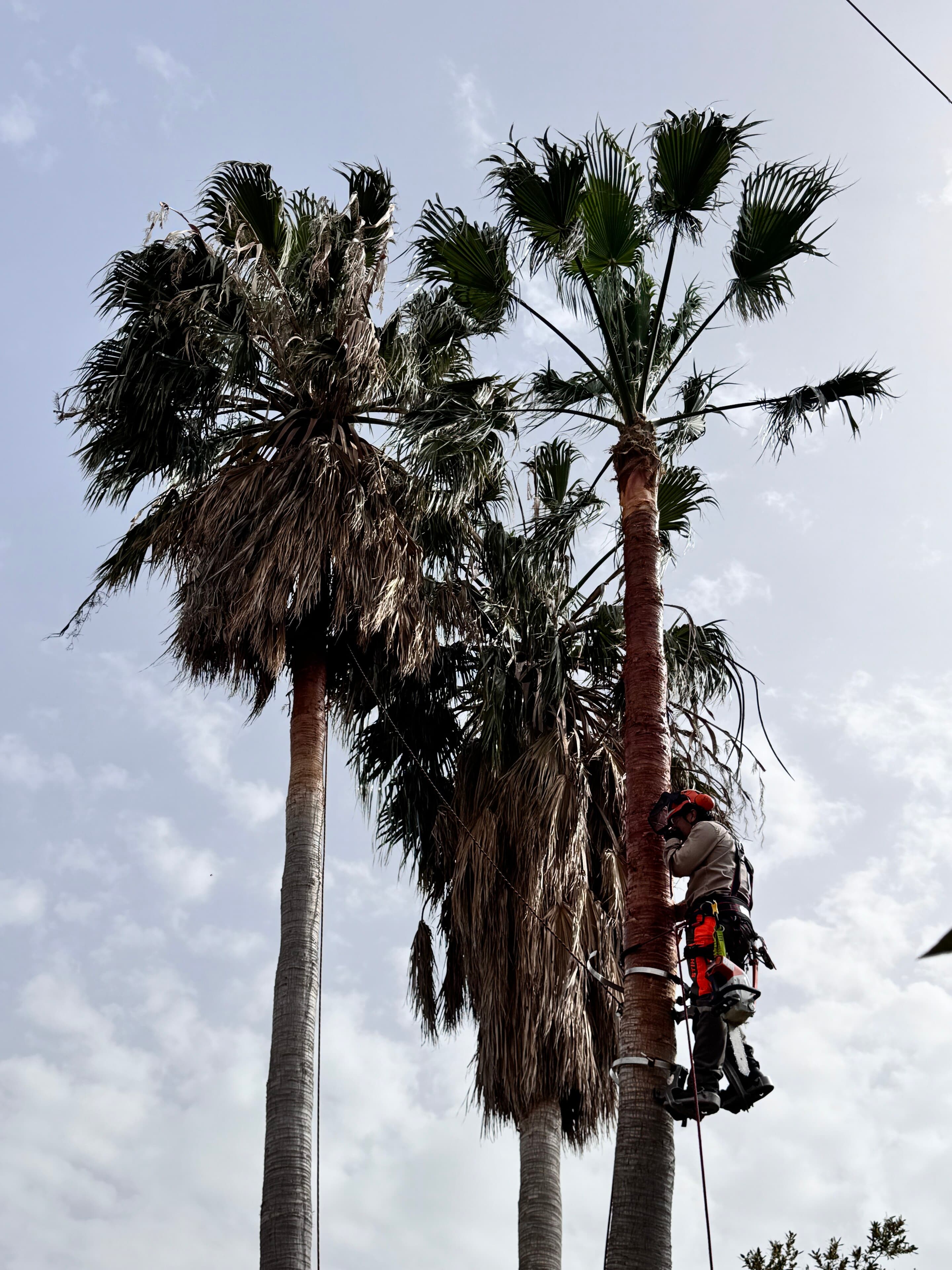
Anyone who has driven along the Mallorcan coast has seen the rows of Washingtonia filifera and Washingtonia robusta that give the landscape its distinctive profile. They are large, tolerant, long-lived palms, but they demand a very specific pruning technique that most gardeners do not get right.
The most common mistake is the “feather cut” or “skirt pruning”: leaving only a few central fronds and removing everything else, leaving a bare trunk and a precarious apical bud. Visually it can look tidy, but the palm loses its active photosynthetic capacity, weakens, and becomes more exposed to pests such as Paysandisia archon, the palm-borer moth.
What the research says about over-pruning
The ANSI A300 standard, summarised in the IFAS Extension publication EP443 from the University of Florida, forbids removing fronds whose tips sit above horizontal (the 9:00 and 3:00 positions on an imaginary clock over the trunk). For Washingtonia specifically, the figures from the ST670 factsheet are clear: a healthy palm keeps at least 30 active fronds and can produce up to fifty new ones a year; over-pruned or potassium-deficient specimens drop to around half or less (Broschat, 1994; UF/IFAS ST670).
Observations after the 2004 and 2005 Florida hurricane seasons were unambiguous: palms cut in the so-called hurricane or rooster-tail style had their crowns snapped off more often than palms with a full canopy. The young fronds that survive an aggressive prune grow smaller than those that preceded them (Endress et al. 2004; Mendoza et al. 1987), and the trunk that supports them develops a narrower diameter in its newest section, a visible narrowing that does not recover, because palms have no secondary cambium and do not heal wounds.
How we do it at TerraLuxe
Our technique is deliberately conservative. We only remove:
- Fronds that are fully dry, brown, with no photosynthetic activity.
- Fronds that present a falling-debris risk over walkways or sitting areas.
- Suckers or growth that distort the natural silhouette of the species.
We do not touch active green fronds unless they are damaged. We do not “clean” the trunk beyond what is necessary. The palm keeps a balanced crown, similar to its natural habitat in California or Arizona.
A well-pruned palm should not be noticeable. If you walk past and think “what a beautifully pruned palm,” it has probably been over-pruned.
Trunk skinning
Once a frond is removed, the petiole base, the sheath, stays attached to the trunk as a woody collar. In Mallorcan gardening jargon this is called “cutear”, trunk skinning: peeling those sheaths off with a very sharp knife, leaving the clean trunk that gives a well-kept Washingtonia its classic “pineapple” silhouette. It is done for three reasons. First, technical access: palm climbing frames need a clean trunk for the padded straps to grip safely. Without skinning, we cannot climb with that technique. Second, sanitation: dead sheaths harbour Paysandisia eggs, weevil larvae and rodent shelter. Third, aesthetics: the clean trunk is the recognisable image of a well-tended palm in squares, estates and avenues.
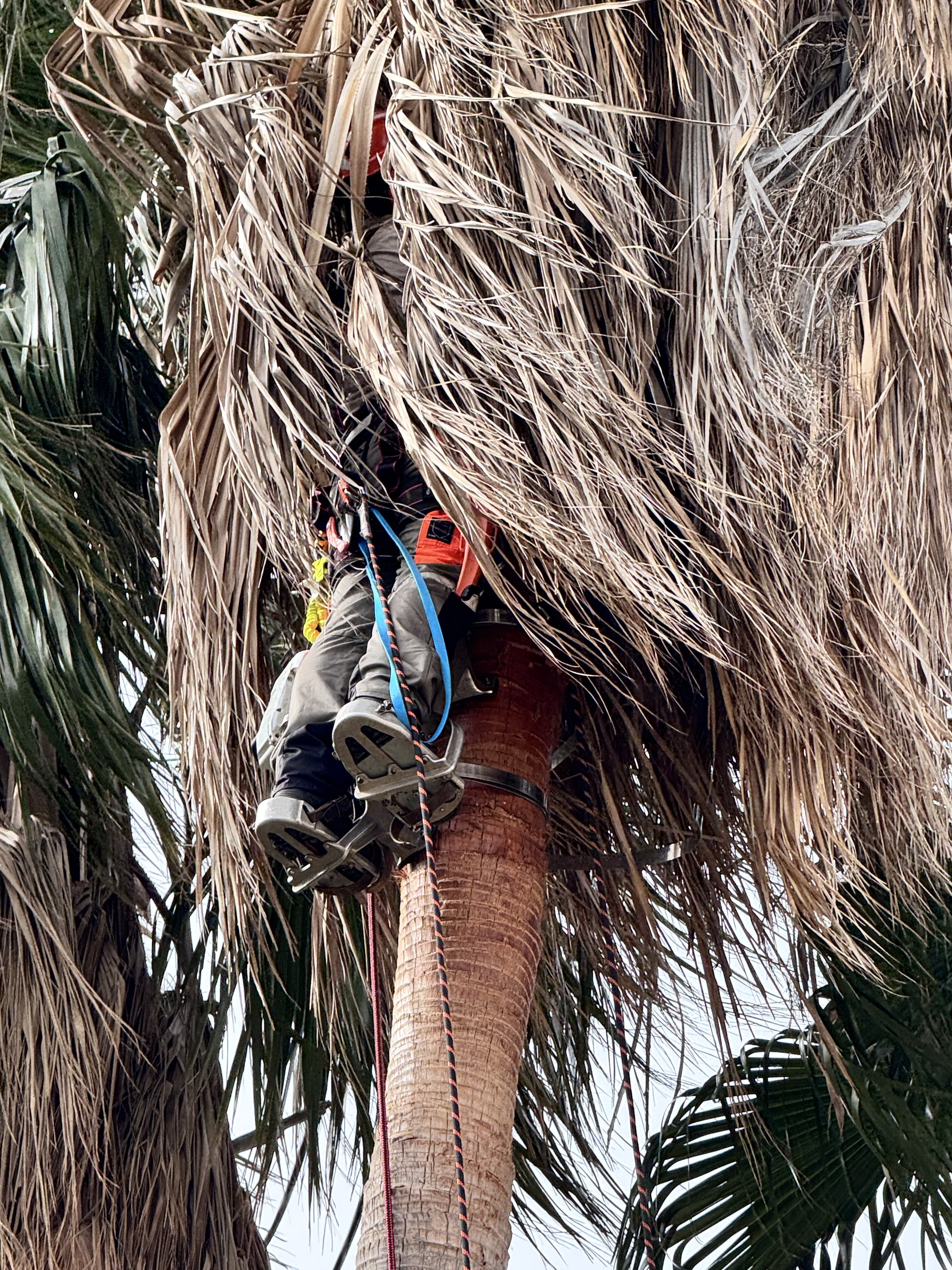
The technique demands a steady hand. The blade slides parallel to the trunk, with just enough pressure to part the sheath without touching the living tissue underneath. Each time the knife bites deeper than needed, the mark stays forever: palms, as we have seen, do not heal. Skinning is craft work and demands a properly sharp blade. Even so, it is the standard in professional palm maintenance: sheaths do not shed cleanly on their own, they hang on the trunk for years collecting plant debris that ultimately harms the palm. On every visit, after the pruning, we skin.
Why physiology matters
Palms do not behave like dicot trees. They have no active cambium, the trunk does not thicken with annual rings, and they depend far more on living fronds to produce energy.
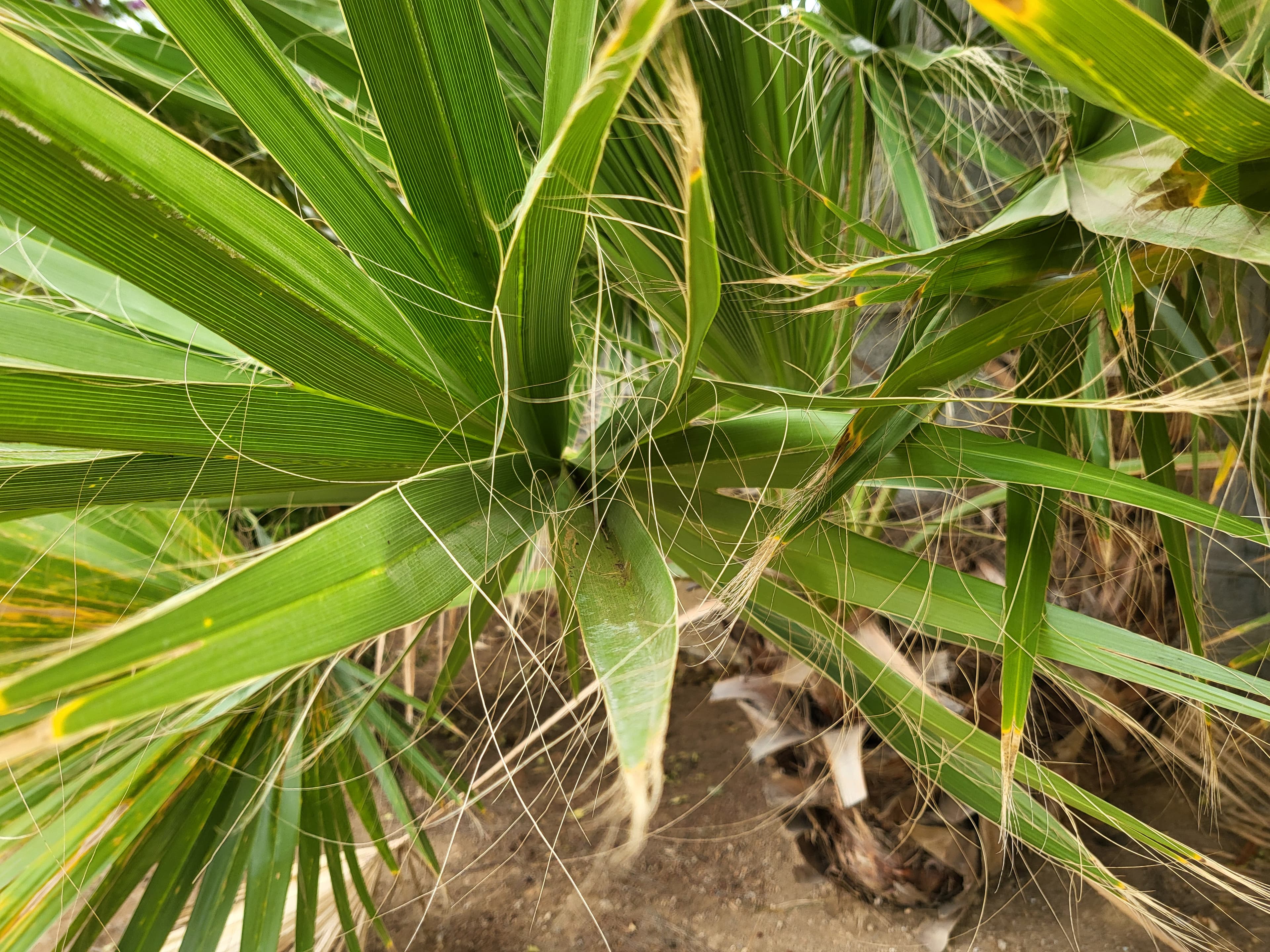
When green fronds are cut, the palm loses photosynthetic capacity that it cannot easily recover. The Washingtonia has a particular trait: it produces new fronds only from its apex (the bud), and if that bud is damaged, by aggressive pruning, by an impact, by an infection, the palm dies. It does not recover.
That is why our technique respects the bud, keeps a generous crown, and prioritises long-term health over instant aesthetics.
Paysandisia, the main threat
Paysandisia archon is a diurnal moth native to Argentina, Uruguay, Paraguay and southern Brazil, introduced to Europe with ornamental palm imports and first detected in Spain in Girona in 2001, reaching the Balearic Islands by 2013 (EPPO Global Database). Today it is the main threat to Washingtonia in Mallorca. Its size is striking, and so are its orange-red hindwings with white spots and a black band, almost decorative. But the damage is not done by the adult; it is done by the larva. The female lays around 140 eggs in the petiole fibre, and the caterpillars tunnel toward the apical bud for ten to eighteen months, the only tissue able to grow new fronds. If they reach it, the palm dies.
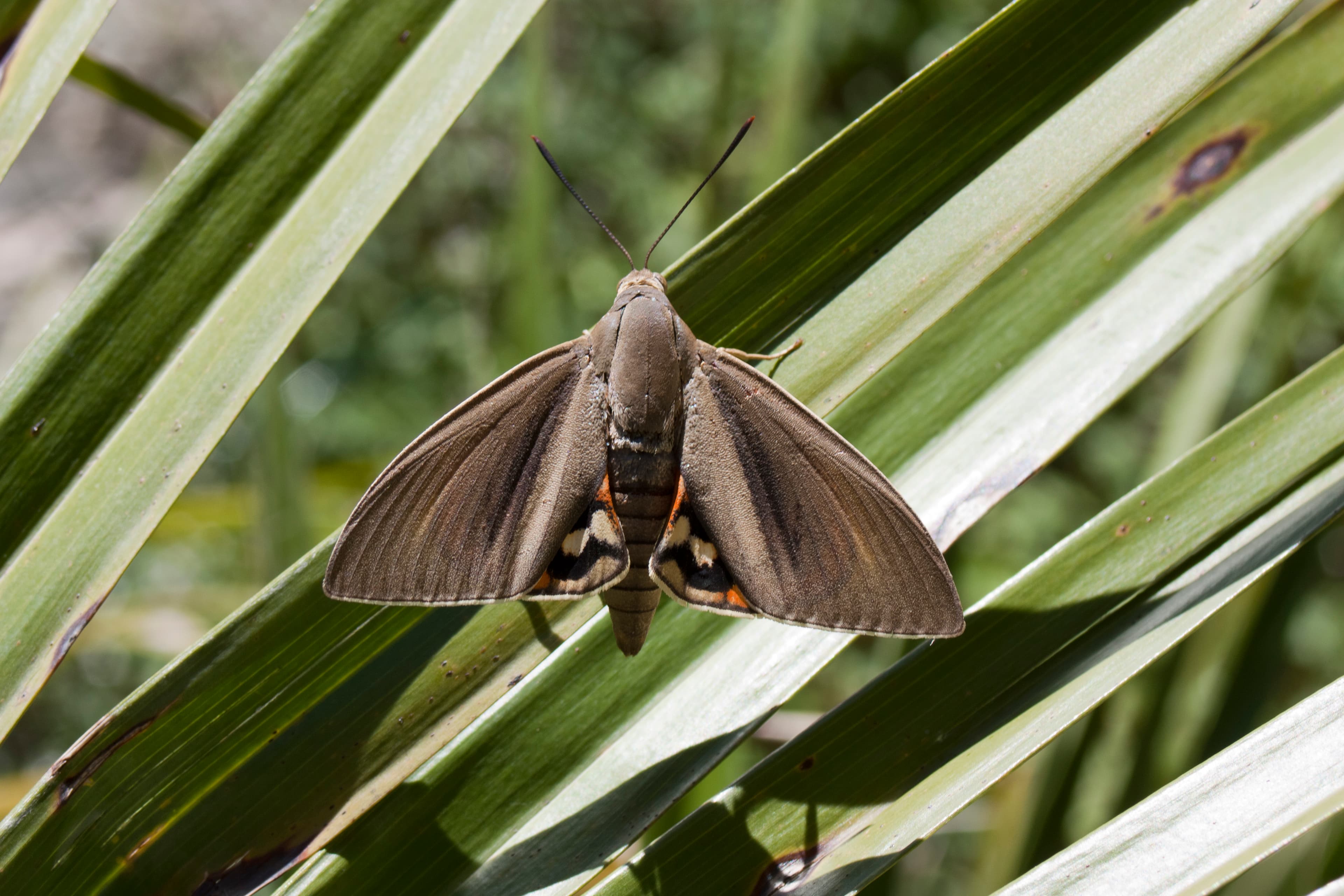
The symptoms appear before the insect itself: round holes in petioles and trunk, fresh frass at leaf axils, perforated young fronds, a drooping or blackened spear leaf. The red palm weevil (Rhynchophorus ferrugineus) is also present on the island, but it attacks Phoenix palms far more than Washingtonia. The scale of the problem is well documented in southern Europe: more than fifty thousand palms were lost in French nurseries between 2002 and 2012, and in affected Italian regions production losses reached 90% in 2003 (EPPO, 2013). Our protocol combines preventive endotherapy in spring, systematic spear-leaf inspection during the flight months of May to September, and immediate response at the first sign. It is surveillance work, not reaction work.
We talk in detail about how we reach a palm, the three methods that exist, and why we never use gaff spurs, in a separate entry.
How to climb a palm without killing itThe result
The result of pruning the way it should be done is not visible from a single visit. It shows over five or ten years. The palms keep their bearing, they resist pest pressure when others fall, and they form part of a landscape that ages well.
It is quiet, almost invisible work. But it is the difference between having a living palm in thirty years, or replacing it every five.
Frequently asked questions
- Why does skirt or feather pruning damage Washingtonia palms?
- Skirt pruning leaves only a few central fronds and removes everything else. The palm loses photosynthetic capacity, the bud is exposed to mechanical damage and pests, and the trunk develops a narrowing that does not recover, because palms have no secondary cambium. The ANSI A300 standard forbids this practice, and Florida hurricane observations from 2004 and 2005 showed that aggressively cut palms had their crowns snapped off more often.
- What is Paysandisia archon and why does it affect Washingtonia in Mallorca so heavily?
- Paysandisia archon is a diurnal moth native to South America (Argentina, Uruguay, Paraguay, southern Brazil), detected in Spain in 2001 and in the Balearics by 2013. The female lays around 140 eggs in the petiole fibre; the larvae tunnel toward the apical bud for ten to eighteen months. If the larvae reach the bud, the palm dies. It is the leading phytosanitary threat to Washingtonia in Mallorca.
- When is the best time to prune a palm in Mallorca?
- From a phytosanitary point of view, late winter or early spring is the optimal window, before the Paysandisia archon flight period (May to September): fresh wounds are less likely to be colonised. In maintenance gardens, summer pruning is also common, done just before the inflorescences and fruit start dropping debris onto terraces and pools; in that case the protocol requires immediate fumigation of the wounds to offset the higher colonisation risk. And if the palm already shows symptoms (entry holes, fresh frass, drooping spear), action is immediate regardless of the season.
- How many fronds should be left after pruning a Washingtonia?
- As many as the palm needs to keep its natural silhouette, without removing any frond whose tip sits above horizontal. The technical reference is the thirty active fronds documented by UF/IFAS ST670 for a healthy Washingtonia; a deficient or over-pruned palm drops to around half. We only remove fully dry fronds, fronds posing a falling risk over paths, and lateral shoots that distort the species' characteristic silhouette.
Sources
The recommendations in this piece combine published technical standards (UF/IFAS ST670 and EP443, EPPO, DEFRA) with our own field observations in Mallorcan gardens. They are not a controlled-sample formal study: if your estate has particular conditions (soil, microclimate, unusual pest pressure, or suspected active infestation), contact us for an on-site assessment.
Adrià Munné
FOUNDER · CERTIFIED ARBORIST
Catalan by family, trained between Mallorca and Zürich. Certified arborist, permaculture designer. He writes in this journal about the craft and the plants that shape the Balearic landscape.