CRAFT · 9 MAY 2026 · 7 MIN READ
How to climb a palm without killing it.
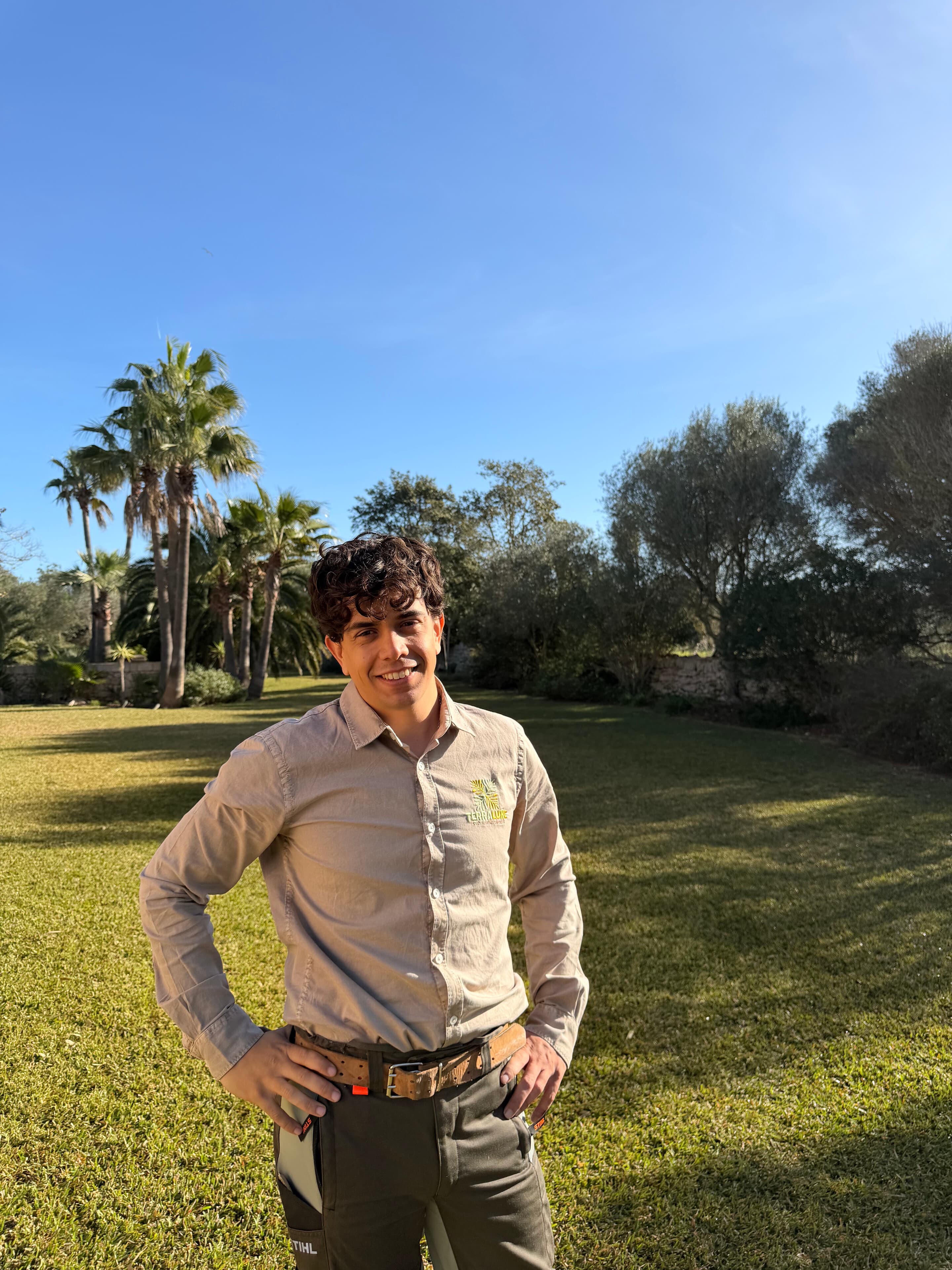
Adrià MunnéFounder, certified arborist
Every palm, sooner or later, becomes a technical problem. The fronds keep growing, the inflorescences fall, weight piles up in a crown that no ground-level ladder can reach. And the question begins: how do we climb?
Anyone who owns a large palm knows this. For years the tree looks after itself, until one day the dead fronds start hanging heavy, the inflorescences drop onto the walkway, the fruit dirties the pool, and the overall posture asks for an intervention. The bud is almost always more than ten metres up, well out of reach of any domestic ladder.
And then the question that reframes everything else arrives: how do we climb up? Because a palm, unlike an olive or a pine, punishes the wrong decision for the rest of its life. This entry explains the three ways to climb, what each one leaves on the trunk, and how to choose well for the palm you happen to have in front of you.
A palm is not a tree
Botanically, a palm is not a tree the way an olive or an oak is a tree. It is an arborescent monocot. It has no secondary growth, no vascular cambium, no annual rings thickening the trunk, and, crucially, it does not heal. What in a dicot is a wound that compartmentalises into new tissue, in a palm stays as a permanent hole in the structure.
This single biological fact, apparently minor, rewrites every care decision: every frond cut, every trunk puncture, every spur stab is a mark forever. The palm cannot repair them. It can only live with them until the sum of wounds, or a pathogen that enters through one of them, ends it.
Three ways to climb
In professional arboriculture practice there are three techniques for accessing a palm. Each one solves the same problem (reaching the crown) in a very different way, and leaves very different traces. They are worth knowing.
The palm climbing frame
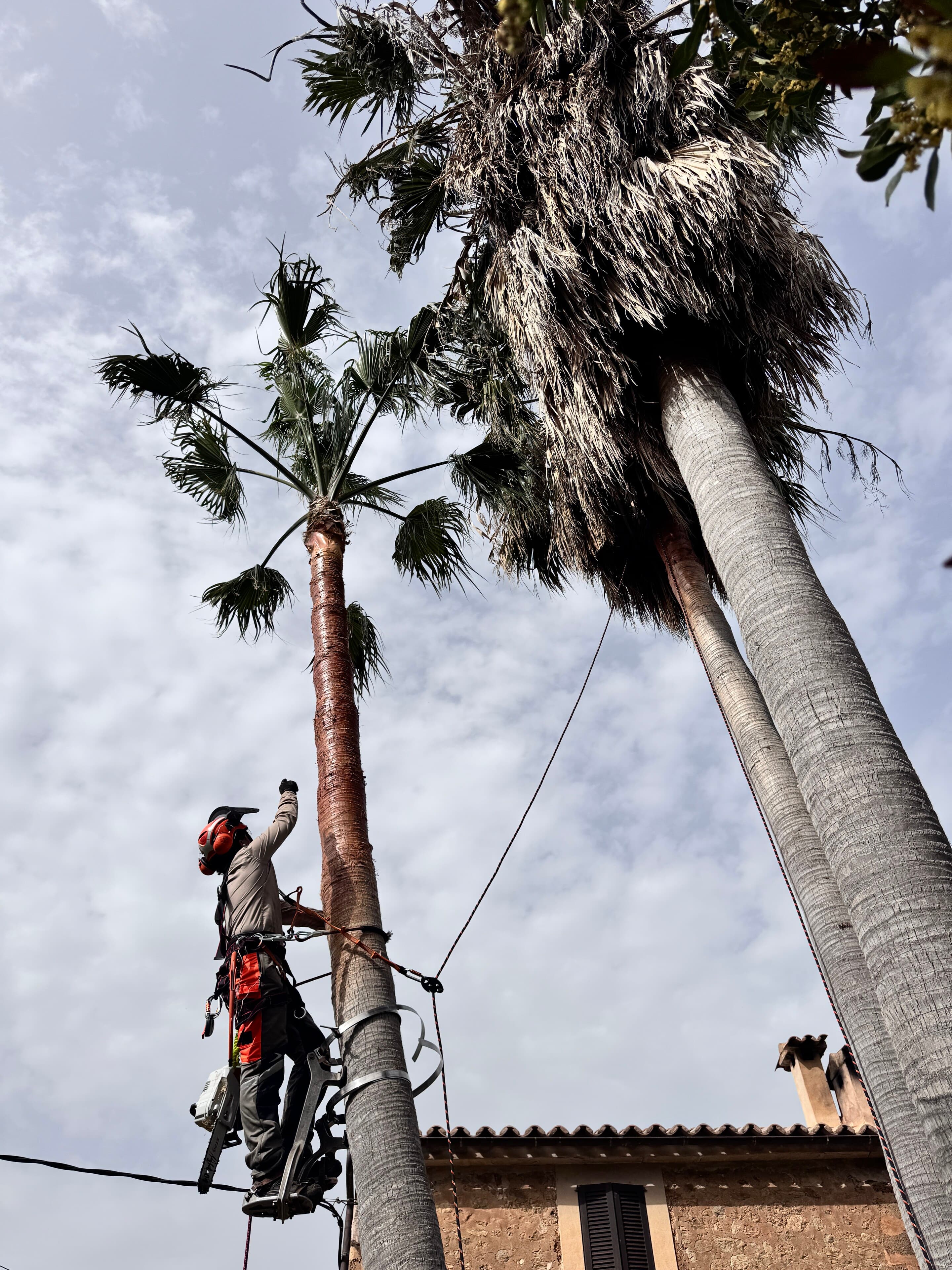
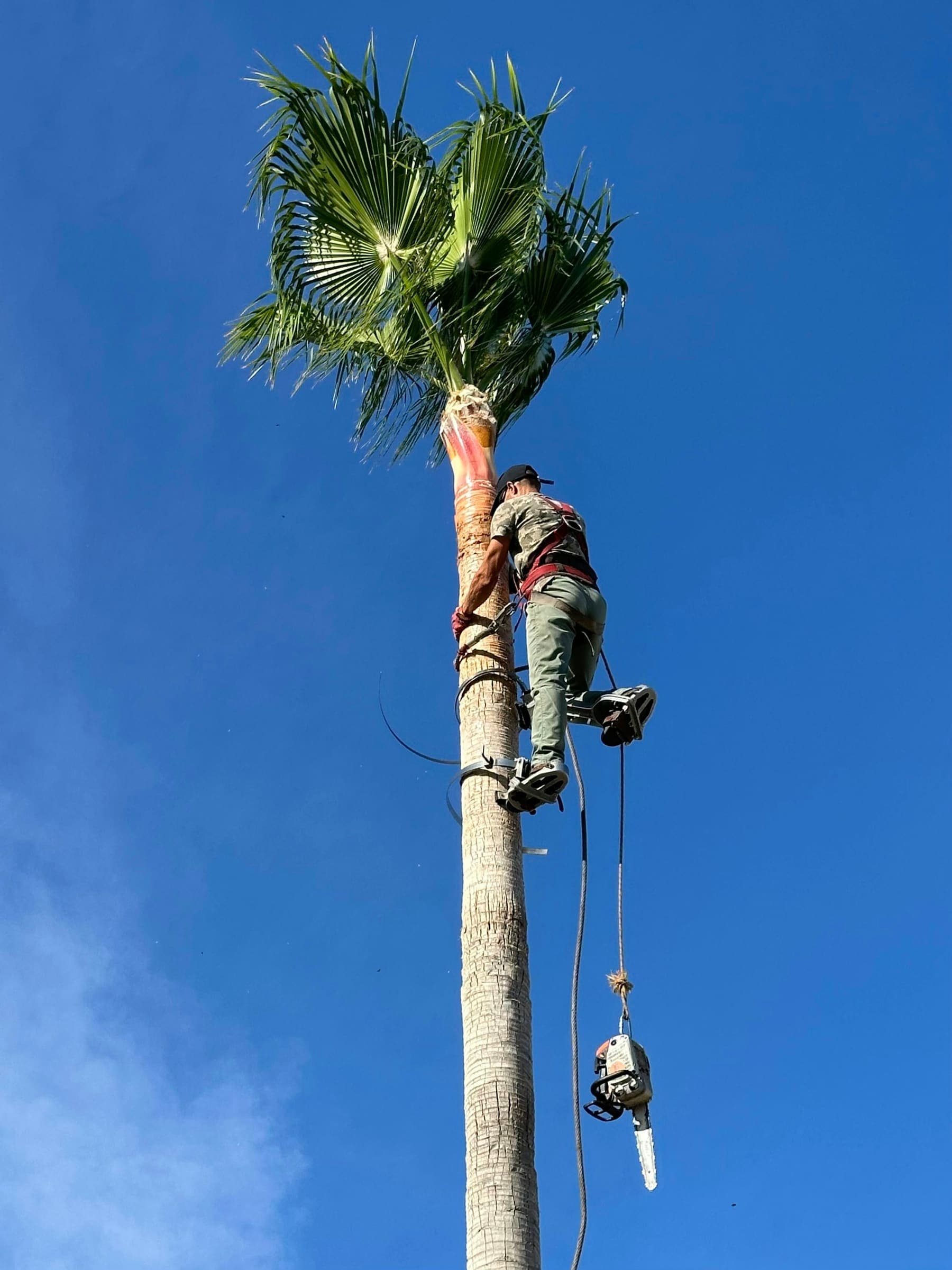
The palm climbing frame (in Spain, “bicicleta palmera”) is a pair of articulated stirrups with wide, padded straps that wrap around the trunk. The climber ascends by alternating weight from one side to the other, sliding each strap upward as the other one bears the load. The trunk takes pressure distributed across broad surfaces, with no penetration. Zero punctures, zero mark.
It is the technique most respectful of the tree, and the favoured one for medium-height palms. The cost is time: setting up and ascending with the frame is slower than climbing on spurs, and on very tall palms it asks for serious physical endurance. On Washingtonias or Phoenix under twelve or fifteen metres, however, the difference in time is barely noticeable.
One condition though: for the frame to grip, the trunk has to be previously skinned. On dry sheaths the padded straps slide and the climb stops being safe. Before going up with this technique we always check that the trunk-skinning work has been done on an earlier visit.
The rope
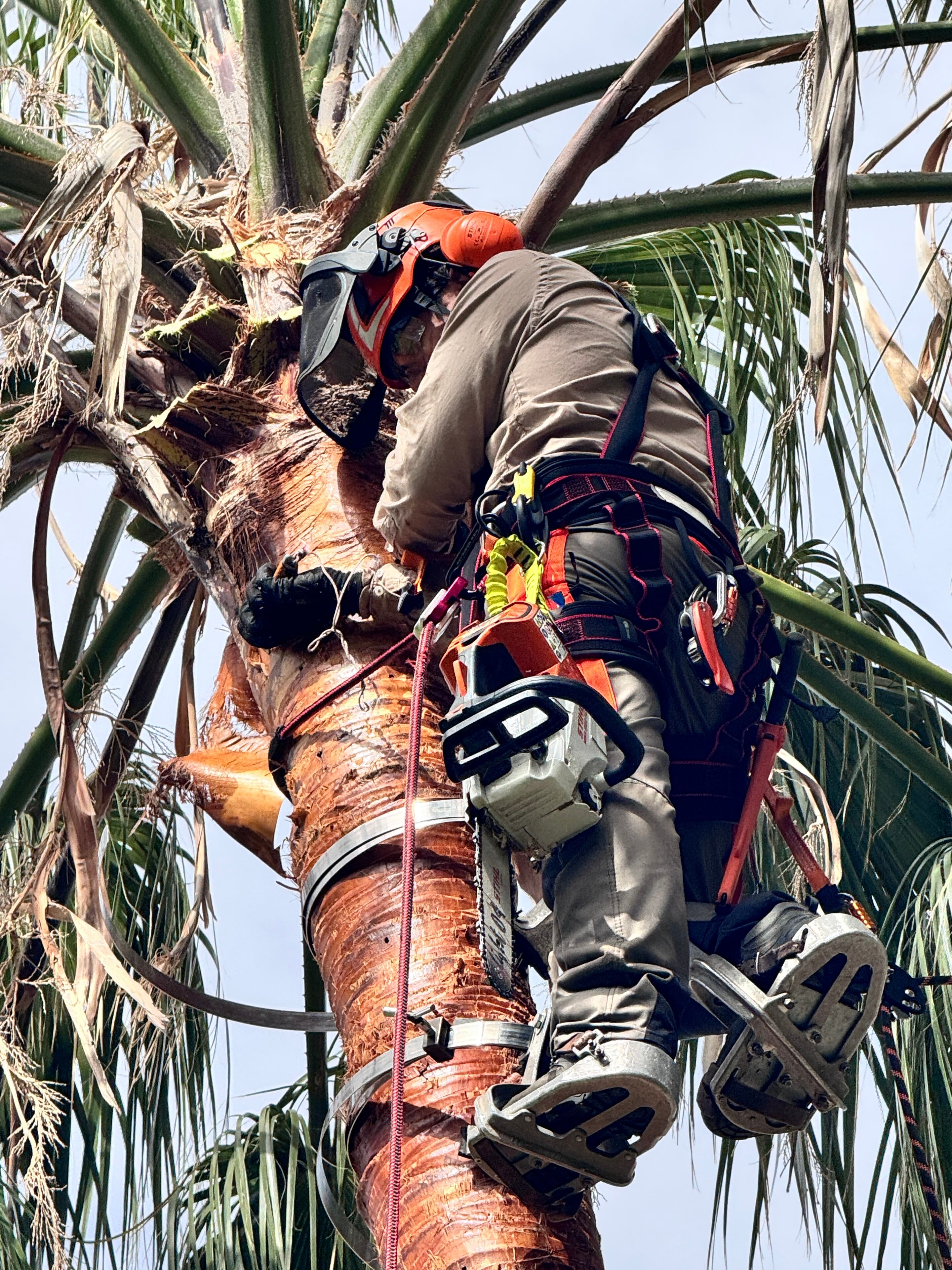
The rope involves anchoring a line at the crown of the palm and ascending on it with mechanical ascenders and foot loops, in SRT (single-rope technique) or DRT (doubled-rope technique) systems. It is the modern arboriculture standard for tall trees. On palms it is used less, because anchoring well in a palm crown is not trivial: the climber has to trust the petioles of live fronds or an artificial structure, and that takes judgement.
When the anchor is resolved well, the rope allows working in positions impossible for the frame, descending under control, and repositioning without going all the way back down. But it has a practical ceiling: above twelve or fifteen metres, setting up a safe crown anchor becomes a huge challenge, and often simply not viable. In the low and medium range the rope shines; above that, the climbing frame takes over.
Gaff spurs
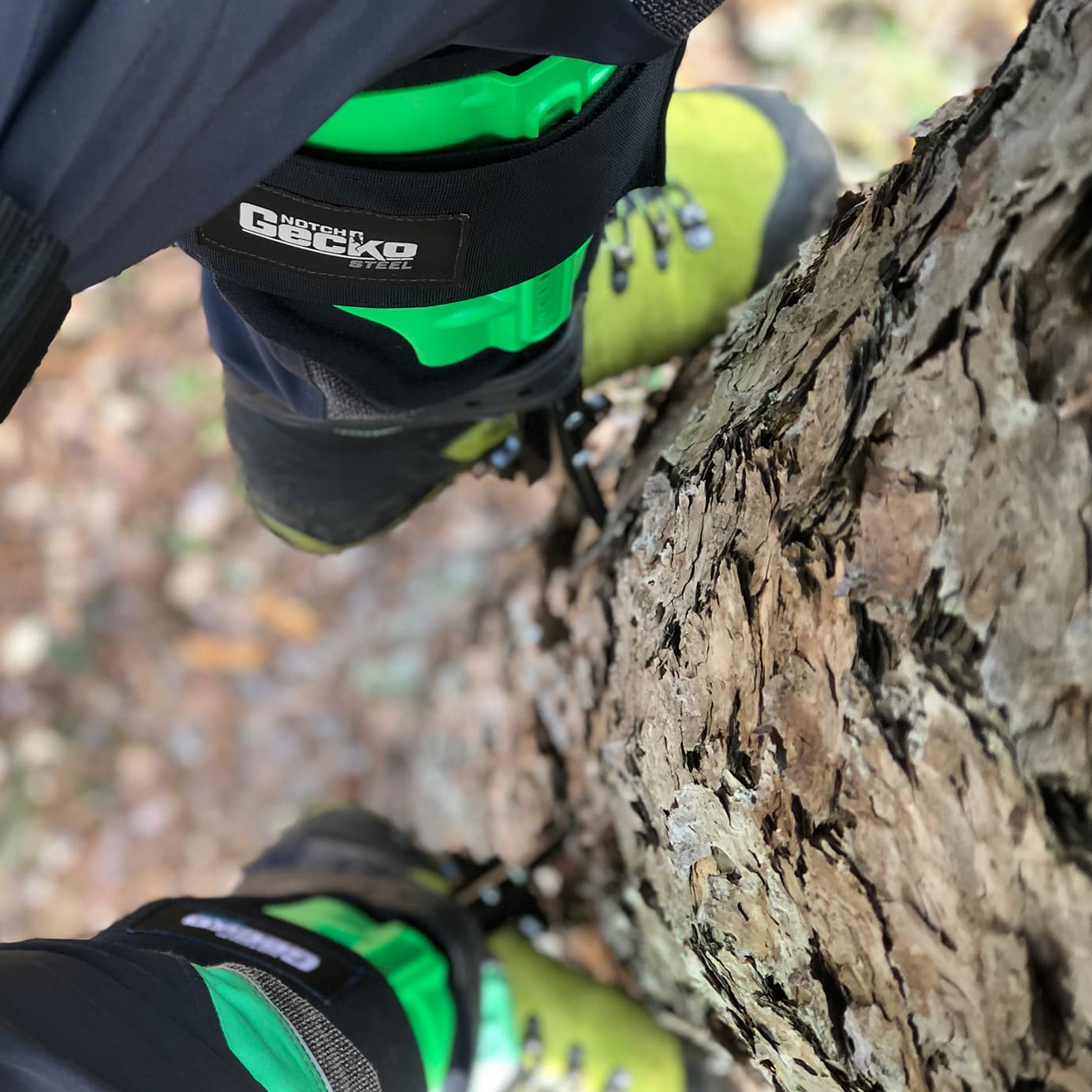
Climbing spurs, also called gaffs, are metal frames strapped to the calf and the foot, with one-to-three-centimetre spikes that stab into the trunk on every step. They make for very fast ascent, with no setup, almost no equipment. They are the standard for telephone poles, for dead trees that will be felled, and, in some regions, also for living trees.
The problem is what they leave behind. Twenty steps up and twenty steps down are forty holes in the trunk. If the palm sees five visits in its life, that is two hundred. On a tree that does not heal, every one of those holes stays open, and together they form a pattern of accumulated wounds that no tissue is ever going to close.
The price of spurs
Spur damage is not visible on the day of pruning: it shows over the years. Every puncture stays open forever, because palms do not heal. Twenty steps up and twenty down are forty punctures spiralling around the trunk; if that palm is climbed five times in its life, that is two hundred. Get close enough and the pattern is visible to the naked eye.
That pattern is not just cosmetic. Every hole is an open channel into the vascular bundles, and through them come soil-borne and air-borne fungi (Thielaviopsis paradoxa, Fusarium species) as well as the two insects that kill palms in Mallorca, Paysandisia archon and Rhynchophorus ferrugineus. The wound pattern works on the tree for years: the palm slowly loses vigour, grows more vulnerable to the next pest that passes through, and dies sooner than it would have.
What the research says
The biological reason behind all of the above sits in palm anatomy. According to the IFAS Extension publication EP473 from the University of Florida, palms lack lateral meristems and a vascular cambium entirely, the structures that in conventional trees produce annual growth rings and let wounds close with new tissue. That is why every trunk wound is permanent. And all future growth depends on a single apical meristem, sitting in the bud at the top of the crown: if that meristem dies, the whole palm dies with it, with no possibility of regrowth.
The red palm weevil (Rhynchophorus ferrugineus) puts numbers to what those open wounds become. Detected in Spain in the 1990s and established in the Mediterranean since the mid-2000s, each female lays between 200 and 400 eggs in fresh trunk wounds. Pruning and mechanical damage emit kairomones that actively attract gravid females. In the Valencia region alone, around twenty thousand palms were recorded dead between 2004 and 2009, with losses estimated at roughly sixteen million euros (EPPO, RHYCFE).
Cuteado and corvellón: the precondition for safe access
The cuteado on Washingtonia and the corvellón on Phoenix are trade techniques that highlight the palm's silhouette and, at the same time, leave the trunk ready for the palm-climbing frame's straps to grip safely, regardless of the palm's height. With a sharp knife on Washingtonia, with the corvellón on Phoenix, the woody sheaths and leaf remains that stay attached to the trunk after the natural drop of the frond are peeled off. They do not remove living tissue. They do not compromise the palm's health. And they are also what makes it possible to work without resorting to spurred spikes.
The point is to do it on every visit. If the cuteado and the corvellón are kept current, the palm is always ready for the climbing frame, no prep work needed. When this is neglected for years, the sheaths build up over metres and metres of trunk, and the first intervention can take a full day of cleaning just to leave the palm in a climbable state.
Why so many palms end up feather-cut
On very tall palms, climbing with the frame or with rope is slow, physically demanding, and expensive per hour. The client wants to keep the visit affordable, and the gardener, in good faith, proposes a solution that sounds reasonable: prune more aggressively in exchange for spacing out the next visit. It is a silent agreement, no bad faith on either side, and its consequence takes years to show.
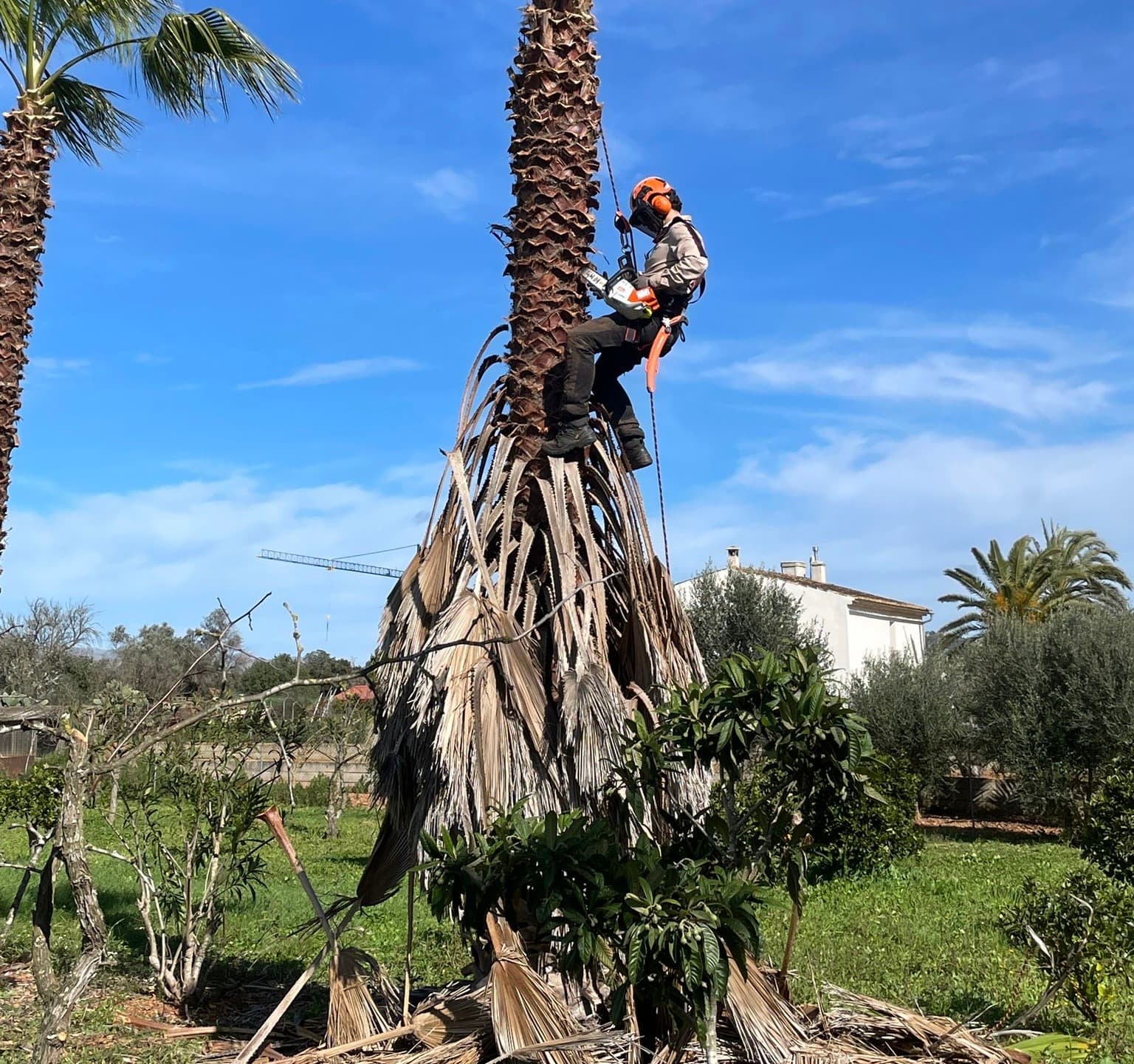
The practice has a name: feather cut or skirt pruning, removing active green fronds until the palm is left with a minimal crown. It drastically reduces photosynthetic capacity, stresses the tree, weakens its defences, and leaves it more vulnerable just when it would need to be strongest to resist Paysandisia and opportunistic fungi. The loop closes on its own: the next gardener sees a weaker palm, returns to spurs because “it is no longer worth rigging anything”, and the palm dies before its second century.
How to choose well
For the owner, no arborist credentials required, the rule is simpler than it sounds: the palm-climbing frame is always the best option and, on very tall palms, the only viable one. Rope makes sense up to twelve or fifteen metres, no more; above that, the height makes the rappel unstable and multiplies the rigging time. Spurred spikes are ruled out for the reasons of the previous section.
The condition that lets the frame work at any height is that the trunk is kept cuteado or corvellonado. That is why these two techniques must be maintained on every visit, year after year. A palm tended continuously takes an hour to be ready to climb; a palm neglected for a decade can take a full day just to prep the trunk before anyone can work on it.
The value of the palm almost always justifies the slow decision. A mature Phoenix dactylifera or a Washingtonia robusta in a Pollença estate may be fifty or a hundred years old. Buying another of the same stature is not possible, and planting one and waiting for it to grow is not either. What is lost cannot be bought.
At TerraLuxe we always climb with frame or with rope. Never with spurs on a living palm. It is slower, and sometimes the client notices it in the quote. But the palm lives decades longer, and in a mature Mallorcan garden, that is the only measure that matters.
Frequently asked questions
- Why are spurred spikes not used on a living palm?
- Because palms do not heal. Each puncture is permanent and acts as an entry point for Rhynchophorus ferrugineus, Paysandisia archon and fungi like Thielaviopsis paradoxa and Fusarium species. An average prune means about forty punctures; five visits over the tree's life are two hundred. The international ANSI A300 arboriculture standard forbids spurred spikes on living trees except for very narrow exceptions like telephone poles or remote utility lines.
- Does rope damage the trunk?
- No. Rope work uses friction on the trunk surface through straps and descenders that spread the load without penetrating it. The limit of rope is not damage but height: above twelve or fifteen metres, installing a safe anchor in the crown becomes slow and unstable, and the palm-climbing frame becomes the only viable option.
- What if my palm has been climbed with spurs several times already?
- The prior damage does not reverse: those wounds are permanent. But from the first work without spurs onwards, no new damage is added. If the palm already shows symptoms (entry holes with fresh frass, drooping or blackened spear, perforated young fronds), inspection and immediate treatment are warranted. If it does not, simply switching technique and keeping cuteado or corvellón current on every visit is enough.
- What is the corvellón, and how is it different from the cuteado knife?
- The corvellón is a curved forged-steel blade with a short handle, similar to a small sickle but stiffer, designed specifically to peel the woody sheaths from a Phoenix trunk. The curvature lets the blade work in contact with the trunk without pulling away. On Washingtonia, the sheaths are softer and come off with a very sharp straight knife. Each palm has its technique and its tool.
Sources
The recommendations in this piece combine the ANSI A300 arboriculture standard, the technical publications from UF/IFAS (EP473) and EPPO data on Rhynchophorus ferrugineus, with TerraLuxe's operational experience in Mallorcan gardens. They do not constitute a formal medical-phytosanitary protocol: if your palm shows active pest symptoms or has a history of spur climbing, we recommend an on-site inspection before any intervention.
Adrià Munné
FOUNDER · CERTIFIED ARBORIST
Catalan by family, trained between Mallorca and Zürich. Certified arborist, permaculture designer. He writes in this journal about the craft and the plants that shape the Balearic landscape.